
Chapter Summary
The chapter discuss the issue of engagement in elearning, pointing out that it may not be as straight forward as it seems or sounds many times. In an in depth analysis, Ruth C. Clark and Richard E. Mayer (2016), examine two forms of engagement; psychological and behavioral.
Psychological Engagement
This is defined as engagement that helps the learner retain information by using various methods that appeal to their cognitive processing. It is basically using a logical and sequential structure and connecting it to what the learner already knows. It builds on top of what has been taught to the learner before. Clark et al.(2016) say this type of learning can occur with or without behavioral engagement (the other form of engagement). It is the primary way in which we learn.
Behavioral Engagement,
This type of engagement, on the other hand, refers to intentional actions taken to enhance learning. This may include games, visuals, manipulative charts, graphics, practical application, and various activities commonly used in learning. Clark et al. (2016) sum up that behavioral engagement may create cognitive distractions that cause a decrease in learning.
The chapter indicates that learners engage and retain information when they have visuals, implement some practice, and/or teach others. The chart below summarizes the different ways learning is enhanced, according to the chapter. They show that learners who are able to teach others what they learn tend to retain the most of what is learned.
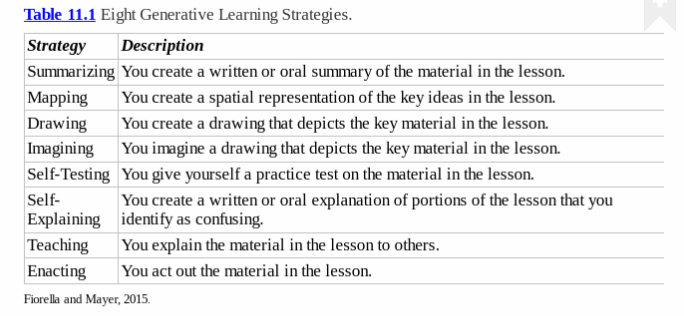
Reflection
I was surprised to discover that games are not an effective method of increasing engagement. In fact, according to the research revealed in the chapter, games cause an unnecessary distraction that takes away from learning. Previously, I was a firm believer in using games to enhance learning. I now have a change of perspective due to the research presented in this chapter. As an educator, I am always working hard to improve and enhance the learning experience for my students I am also always trying to ensure that the learner is retaining as much of what they learn as possible. After reading this chapter, I have realized that some of the methods and commonly used learning tools may in fact impede learning.
I realize that the complexity involved in how the human mind absorbs and retains information cannot be summed up in a few activities, games, or visuals. It is a learning experience for educators to try to figure out how to best engage learners. The chart below shows the four quadrants of learning we can choose to focus on and the fact that when we focus on the fourth one, we become most effective.

We want to keep both psychological and behavioral activity high in order to effectively maximize on engagement in the learning process so as to maximize on learner’s retention. As educators, we walk the tight rope of balancing between information dissemination and maintaining engagement. It is pointless to teach theory when everyone is asleep and therefore clearly not absorbing anything. It is also then pointless, as I have discovered, to lean too far and too strongly on behavioral activity in order to keep students engaged. They will have fun and not learn anything. We have to find the right balance and that is the challenge we face for our entire lifetime.
My reading of this chapter will not affect our ISD project since we seem to have taken a balanced approach already. Our project has a balance of the theory and practical elements. We even have a section where the trainees are expected to train others afterwards. This is considered in the chapter as the most effective way to reinforce learning. This will shape my instructional design prospects and career by causing me to be more concerned about applying the right methods that actually promote learning and not simply behavioral activity. I have been focusing on the wrong things while not fully appreciating what truly promotes learning.
Reference
Clark, Ruth C., and Richard E. Mayer. E-Learning and the Science of Instruction : Proven Guidelines for Consumers and Designers of Multimedia Learning, Center for Creative Leadership, 2016. ProQuest Ebook Central, http://ebookcentral.proquest.com/lib/liberty/detail.action?docID=4418752.
Created from liberty on 2020-02-11 20:10:19.
 Nelson Masinde